




Anonymous Was A Woman - Susan Appleman Unterberg ’59
Susan Appleman Unterberg ’59 is, first and foremost, an artist. Her photography is featured in major institutions across the United States, including the Museum of Modern Art, the Metropolitan Museum of Art, the Jewish Museum, and the Los Angeles County Museum of Art, and she’s been selected for numerous fellowships and residencies such as Yaddo and MacDowell.
Ms. Unterberg’s first experience with photography was in a Brearley after-school program, where she learned how to develop photos. “It’s kind of amazing what’s happened to me since those days at Brearley,” Ms. Unterberg remarks. That would be the end of her photography journey until years later, when she returned to school at Sarah Lawrence College, when her daughters were school-aged, and enrolled in her first photography class.
“There was only one class at that point, it was black-and-white photojournalism, and it was magical to me. I was hooked,” she says.
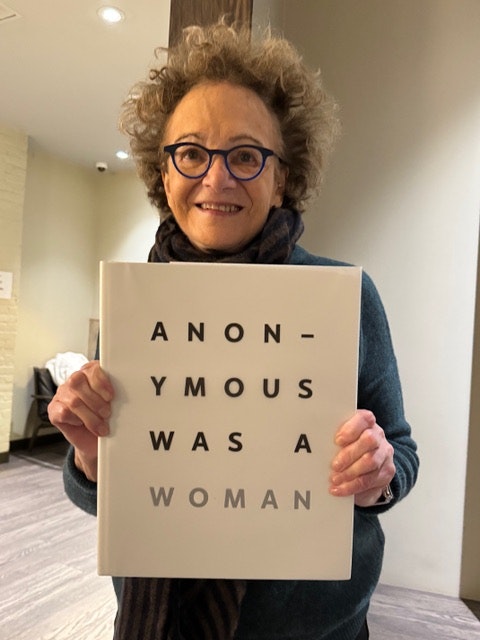
Ms. Unterberg focused on photography and producing innovative work, and soon found herself supporting other artists. In 2018, she came forward as the founder and sole funder of Anonymous Was A Woman, an unrestricted award that annually supports mid-career women artists. Recently, Anonymous expanded from 10 awards of $25,000 to 15 awards of $50,000 per year and now includes trans and nonbinary artists.
She launched Anonymous Was A Woman in 1996, following the National Endowment for the Arts’ termination of grants for individual artists in 1994. “This was my small way of making up for that,” she says. Her father bequeathed his charitable foundation to Ms. Unterberg and her sister. She explains, “I knew I wanted to do something that represented me and not just give money away. I didn’t want to be a philanthropist. I was very happy with my life.”
Ms. Unterberg understood firsthand the challenges mid-career women artists face in finding success in the industry. Through Anonymous Was A Woman, she set out to provide unrestricted grants to women over 40, which she describes as a feminist gesture, and hopes to inspire others to get involved in their own way. “One of my mandates was to encourage other women philanthropists to take action,” she says. Now in its thirtieth year of operation, Anonymous Was A Woman has awarded over $8 million to more than 400 artists in the United States and its territories.
For the first 22 years, Ms. Unterberg remained anonymous for many reasons. “One, I liked my life and I didn’t want it to change. And two, I really wanted the award to be about the artists and not the philanthropist behind it.” Even so, when the New York Times published its first article about Anonymous in 1997, a colleague suspected that she might be behind it, as she was known for being outspoken in her advocacy for women artists.
With the renewed momentum of the women’s movement in 2018, Ms. Unterberg felt compelled to come forward and was encouraged by her daughter to reveal her identity, marking a shift toward more public advocacy for Anonymous.
The program is run entirely by women, and the award is by nomination only. Its name refers to a line from Virginia Woolf’s A Room of One’s Own, and, as the name implies, everyone associated with the organization is anonymous aside from Ms. Unterberg and the program’s director, Ms. Gaby Collins-Fernandez.
According to the grant’s website, “The Award is given in recognition of an artist’s accomplishments, artistic growth, originality and potential.” Each year, Ms. Unterberg personally invites five panelists from across the United States with a broad range of backgrounds— curators, art historians, art writers, former award winners, and museum directors—to meet virtually for an all-day discussion of the nominees.
“It’s very stimulating, and it’s wonderful to hear the discussions,” says Ms. Unterberg. “It’s a lot of work, but the panelists love doing it because they learn about artists they hadn’t previously known about.” She no longer votes since going public, but attends the meetings and, more recently, calls each recipient to share the news.
The response to the award has been tremendous. “It’s amazing how impactful it has been,” remarks Ms. Unterberg. At the end of the grant term, she asks all the artists to write a letter describing how the award has impacted their lives. It’s through these letters that she’s learned about the more personal stories of grant recipients, who have described the award as “life-changing” or coming at “just the right time.”
Many credit the grant for elevating their work, and several others have publicly shared its positive impact on their mental health, noting that they simply needed someone to believe in them. Beyond financial support, Ms. Unterberg remains focused on building a supportive community, saying, “We really trust our artists and pay attention to their concerns as we work on new projects.”
The desire for community led to a first-of-its-kind survey of women artists in the fall of 2024, to better understand their lives, careers, and current challenges. “We all subjectively know the plight of women artists—that they can’t live on their art and they don’t make as much as men, on and on, but it’s never really been codified before in this way,” she shares. “We were hoping the results could be used as a tool for positive change.”
More than 1,200 artists of all ages responded, identifying areas of support and opportunities for change within their industry. Nearly 60% of respondents reported a “strong” or “very strong” sense of community and belonging, and the majority cited community as key to their careers. However, almost two-thirds of respondents noted that museum or institutional backing hindered their careers, and as a result, many (55%) are choosing to sell their work independently. A significant majority (68%) said gender discrimination has had a “negative” or “strongly negative” impact on their experience in the industry, and an overwhelming majority said they experience age discrimination. Only 49% felt that their work was taken seriously.
To share their findings, Anonymous Was A Woman hosted a symposium, “Artists Speak,” in April 2025, coinciding with an exhibit at the Grey Art Museum at New York University showcasing the first 25 years of the award.
While there are no plans for future events or exhibits, a new survey is in development. Ms. Unterberg hopes this and future iterations of the survey influence more potential funders, gallerists, and museum board members to push for change.
“I wish an organization such as ours didn’t need to exist, but it does. We’re very small, but we have an impact,” she says.
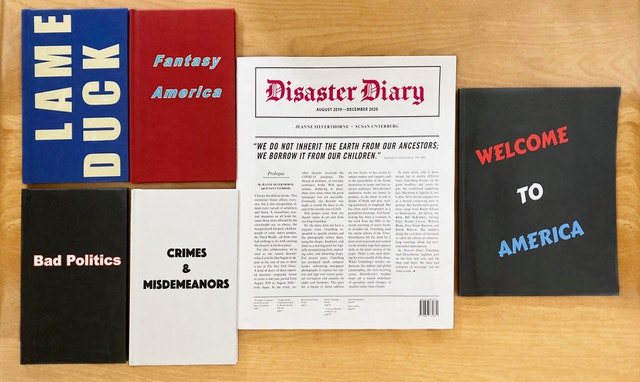
Ms. Unterberg’s recent works, a collection of art books, have taken a more political tone, with titles such as Headlines, Bad Politics, and Crimes & Misdemeanors, to name a few. In 2022, after completing an art book about the environment titled Disaster Diary with her friend and previous grant recipient, Ms. Jeanne Silverthorne, she conceptualized the Anonymous Was A Woman Environmental Art Grant.
“After making that book, I considered what we could do at Anonymous to support more artists,” Ms. Unterberg says. The Environmental Art Grant provides up to $20,000 for environmental art projects in their final phase. “I want to make sure the work gets done. They become more and more amazing each year,” she says. Last year alone, there were over 900 applications in the fifth cycle, and in 2026, the program will award over $470,000 in funding. Anonymous partners with the New York Foundation for the Arts to administer the grant.
As she looks to the organization’s future, Ms. Unterberg shares that her children and grandchildren will take it on. “We’re not finished,” she says. “We’re putting the focus on the amazing work that women do.”
“This is sort of my baby, and I love being able to do it,” she adds. “My world is 90% artists and art. It’s kind of amazing. I feel passionate about Anonymous and very proud.”
For current Brearley students, her advice is simple: “Follow your passion,” she says. “You get a really fine education at Brearley, and I’m glad that they’re honoring the arts.”